
What makes a company hoodie feel worth wearing? It comes down to a comfortable fit, dependable fabric and branding that feels right for the people who wear it, not just the people who ordered it.
Key Takeaways
| Question | Practical answer |
|---|---|
| What makes a hoodie good quality? | Look for a fabric that suits the day, tidy seams, useful details and a fit that allows easy movement. |
| Can a hoodie look professional? | Yes. A clean fit, a considered colour and restrained logo placement give a company hoodie a smart, consistent look. |
| Which features suit different jobs? | Choose warmth and layering for changing conditions, and a practical cut for active work. |
| Should we choose embroidery or print? | Match the decoration to the artwork, fabric and position. Neither method suits every design equally well. |
| How can we find the right team fit? | Ask wearers, try samples during real tasks and consider different body shapes and preferred fits. |
| What is the best first step? | Compare the options in our branded hoodie and sweatshirt collection against your team’s work and comfort needs. |
Comfort is what brings a company hoodie into regular use
A hoodie feels comfortable when its fabric sits softly against the skin, its cut allows you to move, and its weight feels suitable for the day ahead. If a cuff pulls when you reach, a seam rubs under a jacket or the body rides up when you bend, the garment is unlikely to become a favourite.
Comfort also has a psychological side. People often reach for familiar, soft clothing because it feels relaxed and easy to wear, and a useful company hoodie can give staff a simple way to feel part of the team.
Fit should support the work, not just look good in a product photo. Check that sleeves leave room to reach, the shoulders sit comfortably, and the body works both on its own and over the layers people actually wear.
- For desk-based days: prioritise a soft feel, comfortable cuffs and a shape that sits neatly while seated.
- For active days: check shoulder movement, sleeve length and whether the hem stays in place when reaching or bending.
- For layering: leave enough room for a T-shirt or light base layer without making the hoodie feel bulky.
Fabric, weight and construction matter more than a heavy feel
A heavier fabric is not automatically more durable, more comfortable or better suited to the job. Fabric composition and weight work together: cotton-rich fabrics often feel soft and breathable, while polyester can help a garment dry more quickly and hold its shape.
Brushed fleece has a soft, raised inner surface that adds warmth. A lighter hoodie can be more comfortable indoors or under a jacket, while a heavier option may suit cooler conditions when the wearer is not doing strenuous work.
For a concrete comparison, the Stone Unisex Zip Hoodie uses 50% ringspun cotton and 50% polyester brushed fleece at 260 g/m². The Carter Full Zip Hoodie is made from 80% cotton and 20% GRS-certified recycled polyester, with a lined hood and a concealed zip fastening.
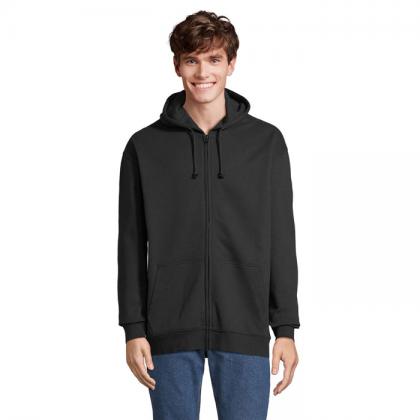
Both styles include practical details such as a kangaroo pocket and ribbed cuffs and hem. Their listed prices are Please Call, with origination, carriage and VAT excluded.
When assessing quality, look closely at seam construction around the shoulders, armholes and pocket edges. Check that stitching is even, ribbing returns to shape and drawcords, zips and pocket openings feel suited to repeated everyday use.
Our Stellar Unisex Hooded Sweat offers another fabric choice: 80% organic cotton and 20% recycled polyester at 280 grams. For a heavier option, the Slam Unisex Hooded Sweater uses a 50% ringspun cotton and 50% brushed-fleece polyester blend at 320 grams, with elastane rib cuffs and hem.
Both are listed as Please Call. The right choice is the one that feels comfortable in the conditions your team faces, not simply the one with the biggest fabric-weight figure.
Choose a style that suits the working day
A pullover hoodie gives a simple, familiar fit. A full-zip style is easier to take on and off as temperatures change, and it lets the wearer adjust warmth without pulling a layer over their head.
For indoor roles, a lighter or mid-weight hoodie can feel more comfortable through a full shift. For outdoor work, think about how the hoodie will sit under a weatherproof layer and whether the hood, pockets and cuffs work with the rest of the clothing.
| Work setting | Features to consider | What to test |
|---|---|---|
| Indoor or customer-facing | A neat fit, comfortable fabric and a clean logo position | Whether it looks tidy while seated and during normal movement |
| Outdoor and changing conditions | Layering room, a practical fastening and cuffs that sit comfortably | Whether it fits beneath outerwear without bunching |
| Active work | Ease of movement and details that stay out of the way | Whether the wearer can reach, bend and carry out tasks freely |
A company hoodie is everyday branded workwear, not protective equipment. If a role involves machinery, moving parts, heat, chemicals or other hazards, use the workplace risk assessment to identify the right specialist garments and controls; loose hoods and drawcords can be unsuitable around moving equipment.
Make the logo work with the garment
Embroidery gives a logo a textured finish and can work well for a straightforward design on a stable area of fabric. Printed decoration can suit more detailed artwork or larger designs, but a large print may feel less breathable and can change how the garment sits.
Choose the method after considering the artwork, fabric and position together. Dense stitching can feel heavy on a soft, lightweight panel, while a broad print may be uncomfortable where the wearer bends or stretches.
Logo placement should reflect how the hoodie will actually be worn. A chest logo is easy to see when the garment is closed, while an oversized hood, an open zip or an outer layer can obscure a design placed too high, too low or close to the centre fastening.
- Keep chest branding clear of the zip and pocket openings.
- Check the logo remains visible with the hood down and with any usual outer layer on.
- Use a size and position that feel balanced on the garment, rather than treating prominence as the main goal.
Good branding supports the garment, it does not rescue an uncomfortable one. When you give someone a useful item with your logo, they interact with your brand repeatedly each time they use it. That works best when they choose to wear it.
Ask wearers and test the fit before ordering for a team
Useful wearer feedback starts with real tasks, not a quick thumbs-up after trying a hoodie on for a few seconds. Ask a small group of staff to wear sample sizes during a normal working day, then gather feedback on warmth, softness, movement, pocket use and how the garment layers.
Include people with different body shapes and different preferences. Some may want a relaxed fit or room for another layer, while others prefer a closer cut; one sample size cannot answer for the whole team.
- Ask staff what they wear during a typical shift and what makes a top uncomfortable.
- Try the hoodie while carrying out relevant work tasks, including reaching, bending and sitting.
- Collect size preferences and feedback on fit separately, so a liked style is not mistaken for a good fit on everyone.
- Use the feedback to settle the style, decoration and size mix before placing the team order.
Make size choice straightforward and private, particularly if staff need different fits or plan to wear a layer underneath. A clear size-selection process helps people choose comfortably without making assumptions about their shape.
Our family-run team on Merseyside has been helping customers with branded merchandise since 1987. We provide personal service and 1 hour quotes, because getting the practical details right is part of the job, not an optional extra.
Care for the hoodie and its decoration
Good care helps the fabric and branding stay presentable through regular wear. Turn the hoodie inside out before washing, follow its care label and use a suitable wash temperature for the garment and decoration.
- Wash with similar colours and avoid overloading the machine, so the garment can move freely.
- Keep high heat away from printed decoration and do not iron directly over a logo.
- Close zips before washing to reduce snagging, and reshape the hoodie after washing.
- Dry it according to its care label rather than relying on a hot tumble cycle.
Embroidery and print can respond differently to heat and friction, so sensible washing habits matter for both. Clear care instructions also help staff look after a company hoodie without guesswork.
Frequently Asked Questions
How can a company hoodie work for staff who do not like wearing hoods?
Offer a zip style that can be worn open or closed, or include a non-hooded sweatshirt as an alternative uniform layer. Giving staff a choice can improve comfort without losing a consistent team appearance.
Should we offer more than one hoodie colour?
A small colour choice can help staff feel comfortable with the garment while keeping the team look coordinated. Choose colours that work with the logo artwork and any other uniform pieces.
How can we collect hoodie sizes from remote or hybrid staff?
Share a size chart and a simple private form, then arrange a sample or fit session at a convenient location when possible. Ask staff to consider the layers they expect to wear beneath the hoodie as they select a size.
Should we order spare company hoodies?
A small reserve can help when a new starter joins, a garment needs replacing or a size choice changes. Keep the reserve aligned with the team’s most common sizes and the style people actually wear.
Are company hoodies suitable for every workplace?
No. They can work well as everyday team clothing, but they do not replace garments selected for specific workplace hazards or protective requirements.
Why do I like wearing hoodies so much?
Hoodies often feel soft, relaxed and easy to move in, making them a familiar choice for everyday wear. Their warmth and casual style can also make them feel comforting and convenient.
Why do I feel more comfortable in a hoodie?
A hoodie can feel comfortable because its soft fabric, relaxed fit and warmth make it pleasant to wear. Familiar clothing can also feel psychologically reassuring and easy to reach for.
Combination
So, what makes a company hoodie feel worth wearing? It is the combination of a comfortable fit, fabric suited to the working day, useful construction and branding that stays visible without getting in the way.
Ask your team, test the hoodie during real work and choose decoration and care instructions with the garment in mind. Get those choices right and the company hoodie becomes a useful part of the working wardrobe, not another item left unworn.
Looking for Branded Merchandise for your next marketing campaign?
Call us on 0151 650 6969
Or use our Contact Form