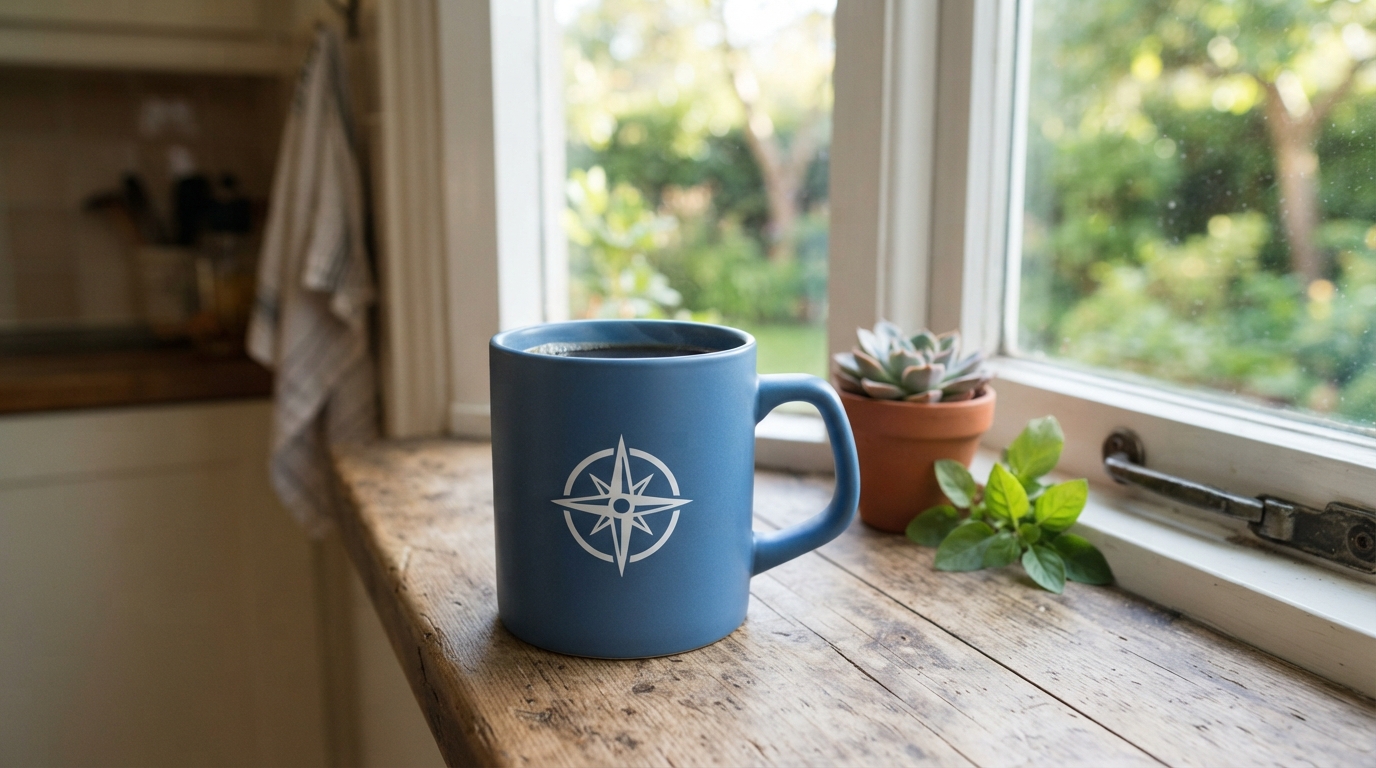
Logo on a mug: where branding stays in view starts with a simple question: who needs to see it, the person drinking or the people around them? Choose the mug, logo placement and print method together, and your branded mug can earn a regular place on a desk rather than end up in the kitchen drawer.

Key Takeaways
- Where should a logo go on a mug? Put it on a broad, easy-to-see side, then decide whether one-sided or two-sided printing suits the way the mug will be held and viewed.
- Which mug shape gives you room to print? A straighter ceramic mug usually offers a straightforward print area. Browse our ceramic mugs to see examples.
- Can a logo wrap around a mug? Yes, some mugs support a wraparound print. Plan the artwork around the handle, curve and print limits.
- Which mug works for commuting? A travel mug is made for carrying drinks on the move. Compare options in our travel mugs category.
- Where can I find mugs with branding? Our mugs and drinkware range includes ceramic and travel mug categories.
- What artwork should I supply? Use vector artwork where possible, outline fonts and provide high-resolution images for any photographic elements.
Choose a mug with a print area that suits your design
The mug’s material and shape determine how much room you have, how the decoration can be applied and what the logo looks like in use. A flat, compact logo can fit a small print area, while a longer brand name or detailed illustration needs more space and a surface that does not distort it.
Ceramic is a practical choice for everyday office mugs. Its glazed surface accepts several common decoration methods, and a conventional mug shape gives you a broad area to work with.
A broad 185 x 75 mm print area sits on the Durham Mug, which measures 90 mm high by 80 mm in diameter and uses direct screen printing; the white version is listed at £2.00.
For full-colour photographic printing, the Photo Mug has a white body and a wraparound dye-sublimation print area measuring 84 x 225 mm; its listed price is £2.00.
Enamel mugs have a metal body with a fired enamel coating. They are typically lighter than ceramic, but the coating can chip if the mug is knocked hard, so consider where and how the mug will be used.
China and bone china are finer, lighter options than standard ceramic. They can suit a more refined presentation, while their delicate feel and shape may call for a more restrained logo size.
Travel mugs often have a narrower, tapered or double-wall body, plus a lid. That means the usable print area can be smaller or shaped differently from a straight ceramic mug, so tailor the design to the cup’s own shape and usable print area.
The SimpliColor 325 ml Ceramic Mug with ColorPop pairs a ceramic body with a colour-pop feature, with a stated lead time of 7 to 10 days and a listed price of £2.00.
Put the logo where people will actually see it
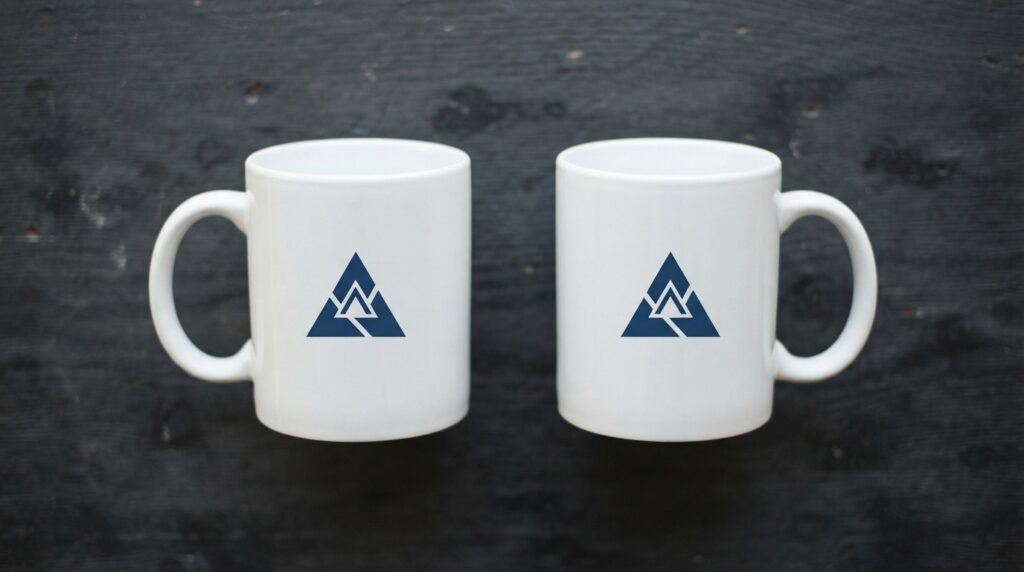
There is no single correct side for every mug. A logo that faces a colleague across a desk may face away from the drinker, while a logo positioned for the person holding it may be hidden from someone sitting opposite.
Start by deciding whose view matters most. For a mug displayed on a counter, face the main logo towards customers; for a gift or office mug that will be picked up and turned, consider printing on both broad sides.
Handle position changes what is visible. A right-handed person may hold the handle differently from a left-handed person, and a mug set down may be turned in any direction, so show the proposed layout with the handle in view rather than approving an isolated logo file.
A two-sided design places a logo on either side of the handle, making it easier to see from different angles. Keep both marks aligned in size and height, and leave enough clear space around them to avoid a cramped look.
A wraparound print can carry a wider design, a sequence of images or a repeated pattern. Keep the main logo away from the handle and any join in the print area, and use secondary graphics to fill space rather than stretching the logo until it loses its proportions.
A mug moves as people lift, drink and pass it across a table. The visual principle of movement is relevant when planning a design, though the eye-tracking result shown here concerns logos in video advertising, not mugs.
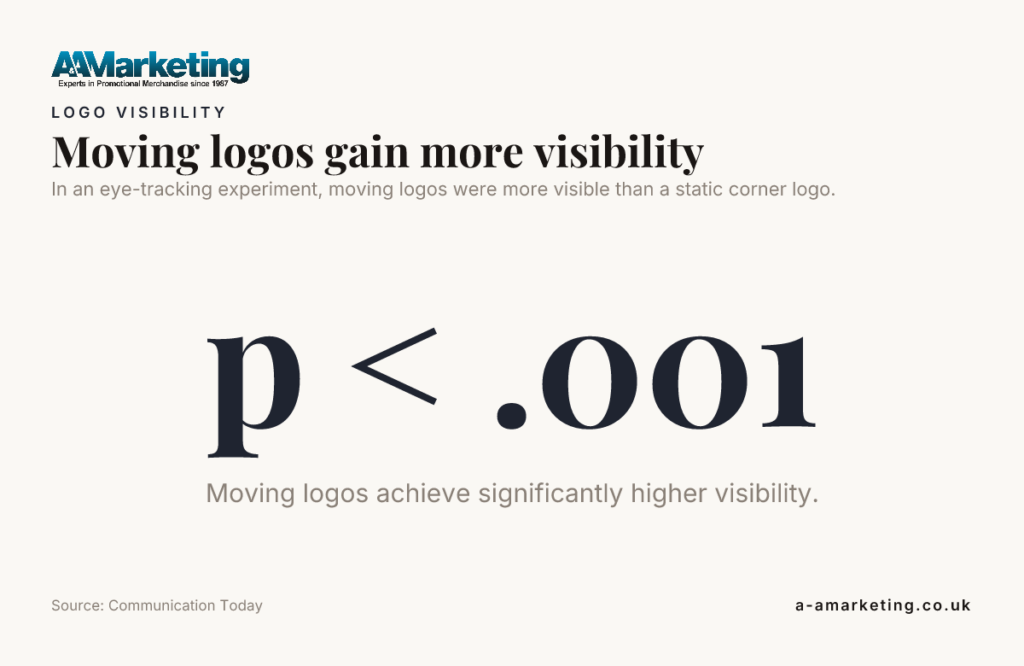
In an eye-tracking experiment, moving logos were more visible than a static corner logo.
Source: Communication Today
Match the printing method to the logo
The right decoration method depends on the mug’s surface and the detail in your artwork. A method that works well for a bold one-colour mark may struggle to reproduce a photograph or fine illustration.
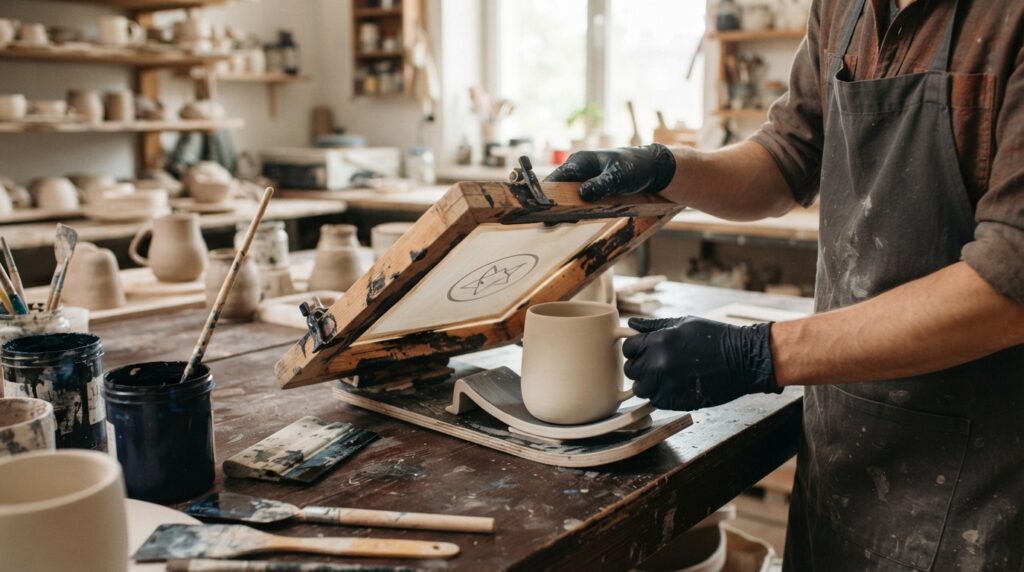
- Screen printing applies ink through a screen and suits solid-colour designs on compatible surfaces. It works well when the logo uses clear shapes and a limited colour palette.
- Pad printing transfers ink with a flexible pad, making it useful for smaller marks and curved areas. With a 300 ml capacity, the Ceramic coffee mug PAOLO uses pad printing and is listed at £2.00.
- Dye sublimation uses heat to transfer dye into a compatible coating. It can reproduce full-colour artwork and photographs, as with the Photo Mug’s wraparound print area.
- Laser engraving marks a compatible surface instead of laying down printed ink. It creates a single-tone finish rather than a full-colour image, so it suits logos that remain clear without colour.
- Decals can reproduce detailed designs on suitable mug surfaces. The firing and finish affect the result, so choose a process intended for the mug’s material and planned washing routine.
Full-colour printing gives you room for photographs, gradients and multi-colour artwork. For a simple logo, a single-colour print can be easier to read at a glance, especially when the mark is small.
An individual gift box accompanies the Zanzibar 355 ml Matte Black Ceramic Mug with ColourPop, which has a matte black, single-wall ceramic body and a high-gloss colour-pop inner; its listed price is £5.00.
Did You Know?
Moving logos achieve significantly higher visibility (p < .001).
Source: Communication Today
Prepare artwork that will reproduce cleanly
Supply vector artwork when you can. AI, EPS and vector PDF files preserve clean edges when the logo is resized, which helps prevent lettering and shapes from becoming soft or jagged.
Outline all fonts so the artwork keeps its intended typeface when opened for production. If your design includes photographs or other raster images, provide raster images at a suitable resolution for the final print size.
Keep small lettering, fine lines and intricate details to a minimum. A logo that looks sharp on a large screen can lose clarity when reduced to fit a curved mug, particularly if the print area is compact.
Plan for contrast against the mug colour. Dark artwork on a dark mug, or pale lettering on a light one, can disappear at a distance; choose colours that keep the main name and symbol distinct.
Allow clear space around the logo and avoid placing key details at the edge of the print area. A mug’s surface curves away from the viewer, and a tapered body can change how a wide design appears near its sides.
Review a mug mock-up before approving production
A flat artwork file shows the design, but it does not show how that design sits around a mug’s curve. Ask for a digital proof on a mug mockup, with the handle visible and the artwork shown from the angles that matter.
Check the logo’s scale, height, orientation and distance from the handle. For a wraparound print, inspect where the design starts and ends, and make sure the main mark is not split by a seam or hidden around the back.
Look at the proof at actual size as well as on screen. Tiny text and narrow gaps can seem clear when enlarged but become difficult to read when printed at mug scale.
Approve the artwork only when the logo, colours and placement are right. If exact colour matching is important, a digital proof confirms layout but cannot fully reproduce the appearance of ink or glaze on the finished mug; request a physical sample for colour-critical work.
Choose a branded mug for the way it will be used
For office use, choose a comfortable shape, a logo that reads across a desk and a decoration method suited to regular washing. A familiar ceramic mug is a tried and tested choice for a shared kitchen or meeting room.
For gifts, consider the finish, colour and presentation as part of the design. A distinctive inner colour or a gift box can make the mug feel considered, while the logo still needs to be clear when the mug is in use.
For promotions, choose a useful mug rather than a faddish widget. When someone uses a practical item repeatedly, they see your brand again and again; that small act of generosity can also encourage reciprocity.
Get it right and it will stay on your customer’s desk and make your phone ring, result! Our family-run approach is built around personal service, and we will help you think through visibility as well as the artwork itself.
Did You Know?
Qualitative cognitive surveys (n = 297) were employed to analyse three distinct logo designs.
Source: Behavioral Sciences via PubMed Central
Care for printed and engraved branding
Washing can affect printed decoration over time. If the mug will be used daily in an office, choose a dishwasher-safe finish and follow the care instructions supplied with it.
Handwashing with a soft sponge and mild washing-up liquid is gentler on many printed surfaces than abrasive scouring pads. Avoid scraping the design with cutlery or stacking mugs so that decorated areas rub together.
Engraving does not rely on a layer of printed ink, but the mug’s surface and finish still determine how it should be cleaned.
Planned
Logo on a mug: where branding stays in view comes down to a suitable print area, a well-planned position and artwork that stays legible on the finished shape. Think about the person holding the mug as well as the people looking at it, then choose a print method and care routine that fit its everyday use.
Useful mugs earn repeat attention because people keep reaching for them. Choose a design that passes the kitchen drawer test, approve it on a mug-shaped proof and your brand has a better chance of staying in view.
Frequently Asked Questions
Can I put a QR code on a branded mug?
Yes, if it has enough clear space to scan and is not stretched around a tight curve. Keep a clear margin around the code, then test a printed sample with several phones before committing to a large run.
Is a digital proof enough if my logo colour must match exactly?
No; use a physical sample to judge the finished ink-and-glaze colour.
Can I put the logo on the bottom of a mug?
You can use the base for a small secondary mark or message, but it will not keep the main branding in view while the mug is being held. Reserve the broad side for the logo people need to recognise.
Should I print a logo on the handle?
A handle is narrow and curved, so it gives a logo less room and can make fine detail harder to read. Use it for a simple accent if the mug and printing process support it, and keep the main brand mark on the body.
Can a logo go inside a mug?
An interior mark is usually less visible during use and can sit where it contacts the drink. Keep the primary branding on the outer body, and discuss food-contact suitability with the decorator if you have a specific interior design in mind.
Where can I find personalised mugs with my company logo?
Look for a promotional merchandise supplier that offers custom printing or engraving on mugs. Choose one with a mug style and decoration method suited to your logo and intended use.
How to permanently mark a coffee mug?
Laser engraving can permanently mark a coffee mug by marking a compatible surface rather than applying printed ink. The result is usually a single-tone design, and the mug’s material and finish determine whether engraving is suitable.
Looking for Branded Merchandise for your next marketing campaign?
Call us on 0151 650 6969
Or use our Contact Form